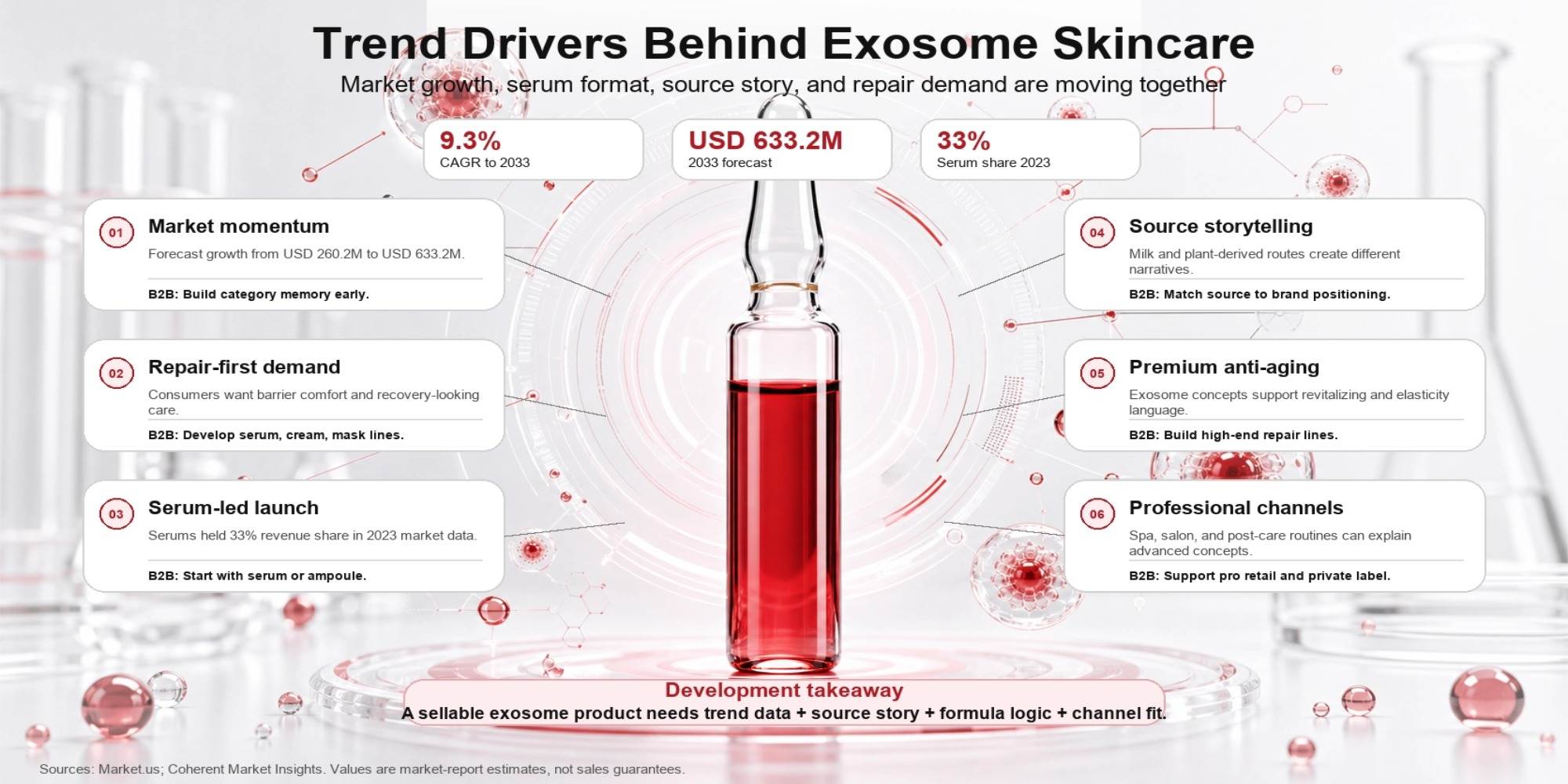
According to Market.us, the global exosomes skincare market is projected to grow from USD 260.2 million in 2023 to USD 633.2 million by 2033, with an estimated CAGR of 9.3%. Another report from Coherent Market Insights estimates that the global exosomes skincare market will reach USD 460.0 million in 2026 and grow to USD 819.4 million by 2033, with a projected CAGR of 10.1%.
These numbers show a clear direction: exosome skincare is no longer only a laboratory concept. It is entering brand development, functional skincare, professional care, and premium repair product competition.
For global skincare brands, importers, cross-border e-commerce sellers, spa and salon channels, and private label customers, the real question is not only whether exosomes are trending. The better question is what kind of exosome concept is easier for consumers to understand, and what kind of exosome product can be developed into a sellable, export-ready, and repeat-order skincare solution.
This is why milk exosomes are attracting more attention. For a skincare OEM/ODM factory like Aisen Pro Skin, exosomes are not only a concept for marketing traffic. They are also a product development direction that can be extended into serums, ampoules, creams, masks, and recovery skincare sets. Aisen already has a plant-derived active vesicles recovery serum solution and is also building product reserves around milk exosomes, allowing different customers to choose a more suitable exosome concept according to their market positioning.
1. Why Exosome Skincare Is Becoming a Hot Topic
Over the past few years, many popular skincare ingredients have been concentrated in several familiar directions. Niacinamide is linked with brightening. Vitamin C is linked with antioxidant care and radiance. PDRN is linked with repair and elasticity stories. Peptides are linked with anti-aging and firming. Ceramides are linked with barrier care.
As these ingredients become more mature, brands need new technology concepts to create differentiation. Exosomes fit this demand well because they can connect with advanced repair, barrier support, recovery-looking care, skin revitalizing, anti-aging support, sensitive skin comfort, and high-tech skincare positioning.
The trend is also supported by a wider shift in consumer preference. Many customers are becoming more careful with aggressive products and are looking for formulas that feel advanced but still comfortable. Instead of only chasing a stronger exfoliating or whitening message, brands are increasingly building stories around barrier care, visible recovery, healthy-looking skin, glow, and long-term skin condition. This gives exosome concepts a stronger commercial role in repair skincare.
However, brands need to be careful with cosmetic wording. Exosome skincare should not be described as a medical treatment. Claims such as cell repair, tissue regeneration, inflammation treatment, or wound healing should be avoided in cosmetic product communication. More suitable skincare language includes helping skin look healthier, smoother, more comfortable, more radiant, and better supported in barrier care.
2. Why Milk Exosomes Are Suitable for a Skincare Ingredient Story
Milk exosomes, also called milk-derived exosomes or milk extracellular vesicles, are nano-sized extracellular vesicles naturally present in milk. Public research describes milk-derived exosomes as containing lipids, proteins, and microRNAs, and they are being studied in areas related to active delivery, skin barrier support, and comfort in skincare formulation science.
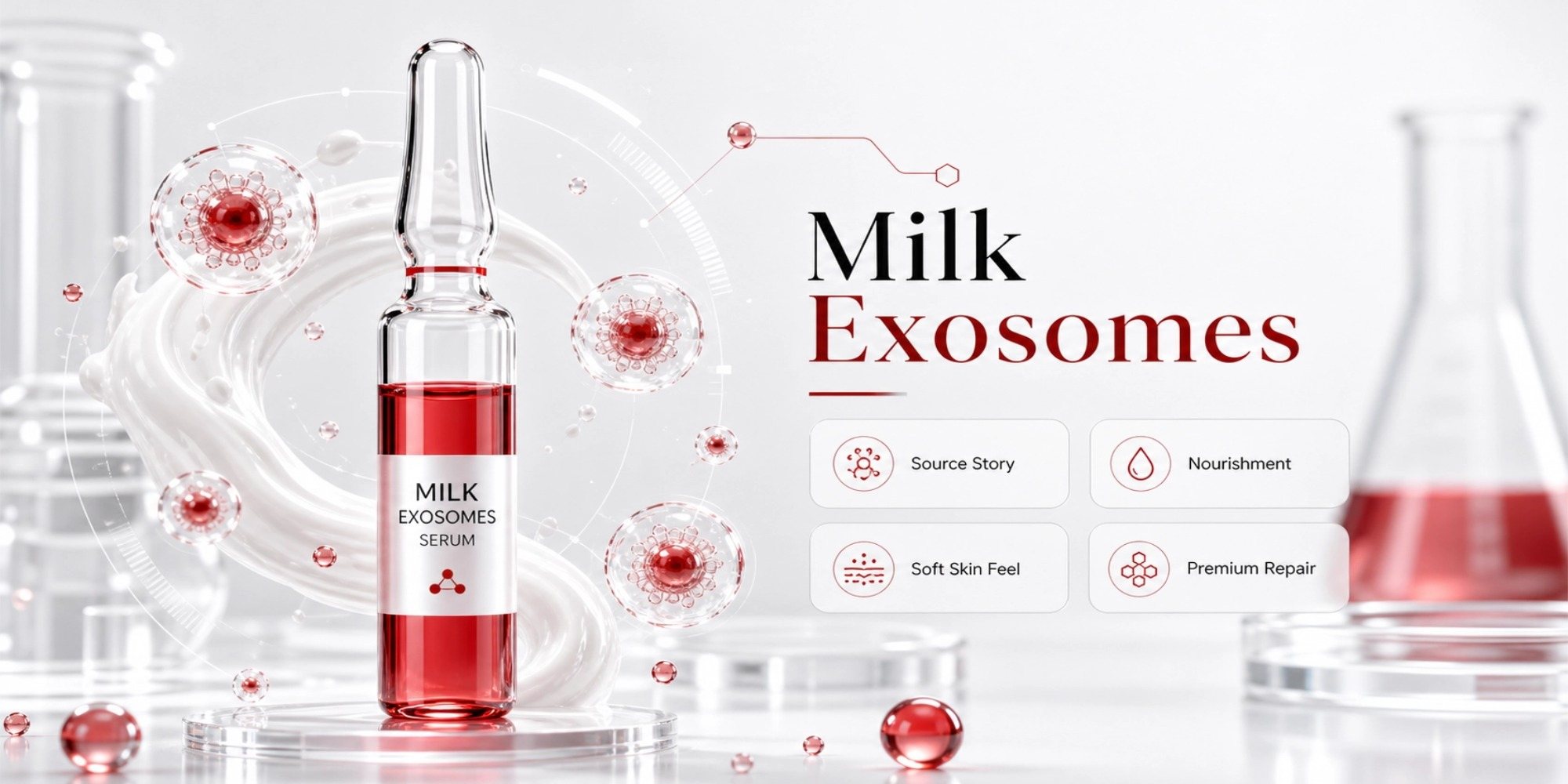
Compared with some biotechnology ingredients that are difficult for consumers to understand, milk exosomes have one strong advantage: the source story is easier to remember. Milk naturally reminds consumers of nourishment, softness, comfort, nutrition, and premium repair. For brands, this source story is easier to translate into product pages, short videos, sales materials, and packaging concepts than a complex technical term alone.
This also makes milk exosomes especially useful in content marketing. A brand can build an ingredient story around milk-derived technology, nano-vesicle care, nourishing repair, soft skin feel, and premium recovery skincare. For e-commerce and independent websites, this gives the product more search and storytelling angles than a basic moisturizing product.
In repair-focused skincare, milk exosomes can naturally connect with dry and rough-looking skin, weak barrier feeling, seasonal sensitivity, post-treatment daily care concepts, fine lines, plumper-looking skin, dull and tired-looking complexion, reduced radiance, and premium spa care experiences.
3. Trend Analysis: Why Serums and Ampoules Are the Best First Step
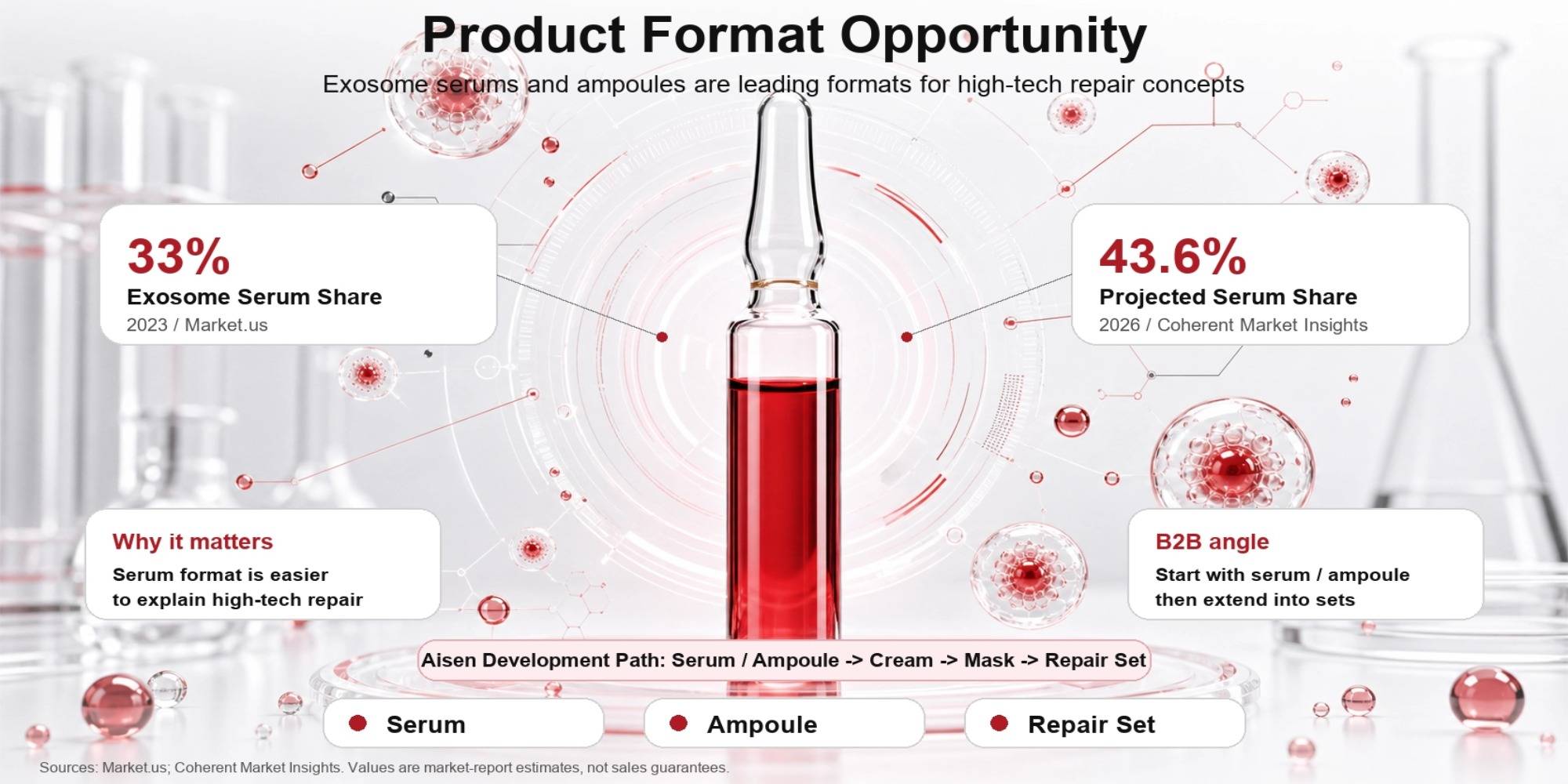
From a market perspective, exosome-related products are most suitable for serums and ampoules as the first development direction. Market.us reported that exosome serums accounted for about 33% of revenue share in the exosomes skincare market in 2023. Coherent Market Insights also projects that exosome serums will contribute the highest product-type share in 2026, at about 43.6%.
This is not surprising. Serums already represent higher concentration, stronger efficacy positioning, and advanced active ingredients in the consumer mind. When a brand wants to introduce a new technology concept such as milk exosomes, a serum or ampoule gives the product a more natural premium position than a basic cleanser or toner.
For B2B customers, this suggests a practical launch path. A startup brand can begin with a milk exosome repair serum. A spa channel can use an exosome ampoule as a professional-looking retail product. A premium brand can develop an exosome recovery cream or anti-aging repair set after the first serum gains recognition. Importers and wholesalers can also use serum-led launch logic to test demand before expanding into masks, creams, and sets.
From a factory development perspective, Aisen tends to first apply exosome concepts to high-perception products such as serums, ampoules, and recovery creams. These categories make it easier to express the value of advanced active ingredients and help brands explain repair, barrier support, comfort, and radiance in product pages, independent-site content, and sales materials.
4. How Milk Exosomes Can Be Combined with Other Actives
Milk exosomes should not be positioned as a single miracle ingredient. For products that need to be launched and sold, they should be combined with mature active ingredients to create a complete formula logic.
This is also something Aisen pays close attention to in exosome product development. For B2B customers, exosomes can provide a high-tech ingredient story, but the real commercial value often depends on how they are combined with other proven skincare ingredients. A good exosome product should not only say contains exosomes. It should make it clear what skin concerns it targets, what usage scenario it fits, and why consumers should try it.
Milk exosomes can be paired with ceramides for barrier support, hyaluronic acid for hydration and plumper-looking skin, peptides for anti-aging repair concepts, centella or panthenol for soothing care, PDRN for premium recovery and glow, or niacinamide for repair plus brightening. This formula logic makes the ingredient easier to translate into different product stories and price bands.
For B2B customers, the real value is not only whether the formula contains milk exosomes. The value is whether the factory can develop them into a product with a clear formula logic, comfortable texture, complete selling points, supporting documents, and market-fit positioning.
5. Milk Exosomes Are Not Suitable for Every Brand
Although milk exosomes have a strong premium repair story, they are not suitable for every brand. If a brand focuses on vegan, plant-based, 100% botanical, or strict plant-derived positioning, milk exosomes may not be the best fit. In some markets, customers may also need to consider animal-derived ingredient perception, dairy-source communication, allergen-related wording, halal requirements, label expression, and local regulatory expectations.
This does not mean milk exosomes are a weakness. It means the source strategy should match the brand position. Therefore, when Aisen recommends exosome concepts to customers, it does not simply say that one source is always better. Instead, the team first considers the customer's target market, sales channel, brand positioning, and label requirements.
If the customer wants to emphasize premium nourishment, milk-derived technology, and professional repair, milk exosomes can be a memorable direction. If the customer cares more about plant-derived skincare, clean beauty, or vegan storytelling, plant-derived active vesicles may be a better fit. This flexibility matters because the exosome trend is not one single formula route; it is a product concept platform that can be adapted to different markets.
6. How Aisen Helps Customers Develop Exosome Concept Products
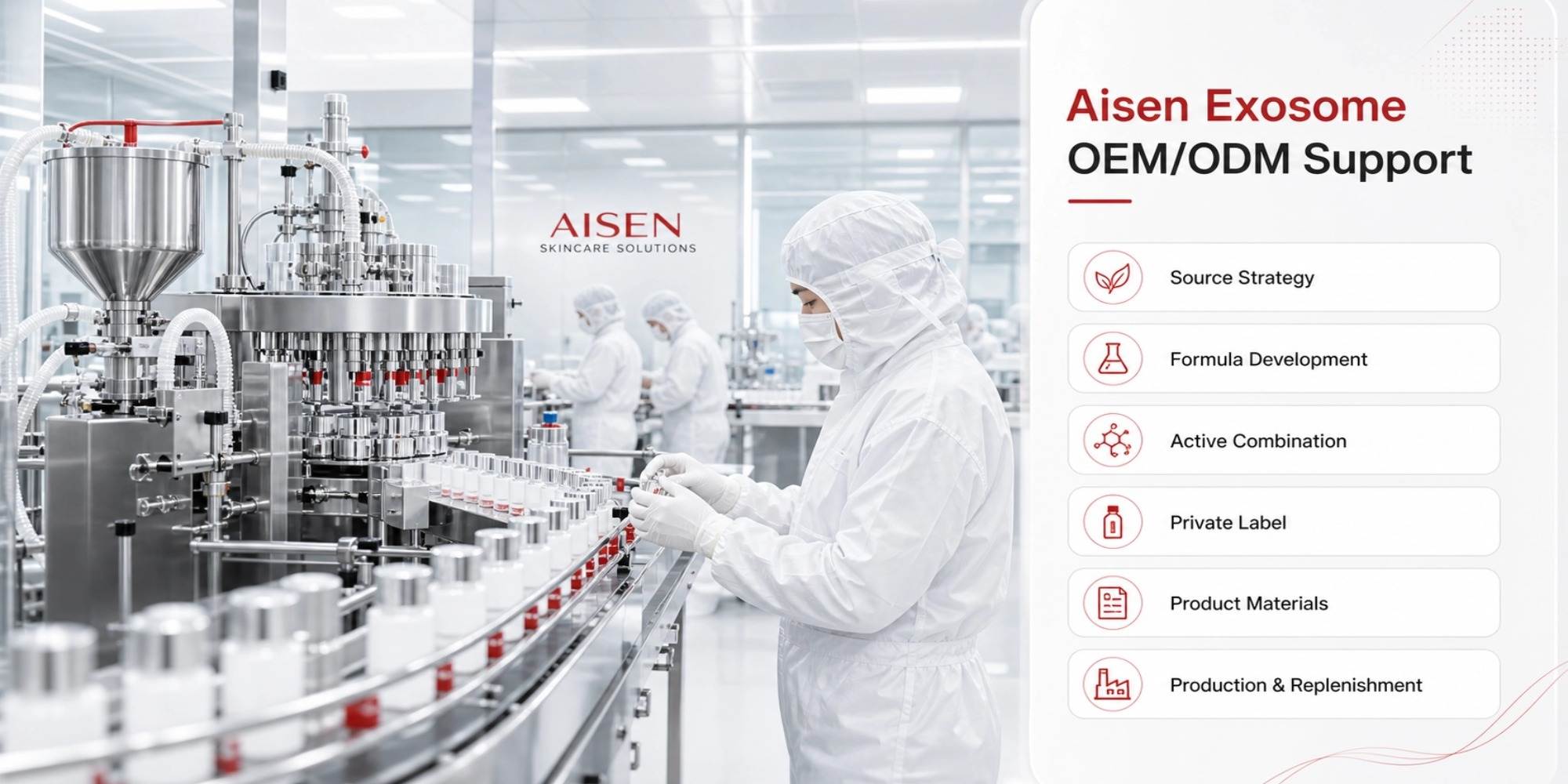
For many B2B customers, the challenge of exosome product development is not only finding a new ingredient. The harder part is turning the concept into a real product that can be sold. This requires source selection, formula combination, texture design, packaging, product documents, export files, and replenishment capability.
Aisen Pro Skin already has a Next-Gen Exosome Technology Plant Peptide Recovery Serum solution, featuring plant-derived active vesicles, plant peptides, ceramides, and hyaluronic acid. It is suitable for barrier support, sensitive skin care, daily recovery, and private label development. At the same time, Aisen also has product reserves in the milk exosome direction and can further develop milk exosome serums, exosome ampoules, recovery creams, masks, or complete recovery sets according to customer needs.
Aisen's advantage is not only offering a trending ingredient. The value is helping customers turn the exosome concept into a more complete OEM/ODM/OBM product solution. Customers can choose milk exosomes, plant-derived active vesicles, or combine exosome concepts with ceramides, hyaluronic acid, peptides, PDRN, centella, panthenol, and other ingredients to build clearer repair, barrier care, anti-aging, or post-care positioning.
In production and delivery, Aisen has 3,000+ mature skincare formulas, 12 automated production lines, a 100,000-grade clean workshop, GMPC and ISO 22716 standards, and annual capacity of up to 80 million units. This allows Aisen to support global customers from sample development, small trial orders, and packaging selection to stable replenishment.
Conclusion: The Opportunity of Milk Exosomes Is Not Only That They Are New
The exosome skincare market is growing, and consumers are paying more attention to high-tech repair, barrier support, sensitive skin care, and anti-aging recovery concepts. The value of milk exosomes is that they combine the advanced feeling of exosome technology with the nourishment, softness, and premium repair story of a milk-derived source.
For B2B customers, however, the real opportunity is not only finding a new ingredient. It is finding a factory that can turn the ingredient into a mature skincare product. If you are developing a milk exosome serum, exosome ampoule, recovery cream, post-care skincare set, or private label exosome skincare line, share your target market, sales channel, source preference, packaging needs, and order quantity with Aisen. Aisen can recommend milk exosome, plant-derived active vesicle, or combined exosome OEM/ODM/OBM skincare solutions to help your brand turn a trending ingredient into a product better suited for global markets.
China Anti-Aging & Brightening Salmon PDRN Facial Serum Supplier | aisenproskin.com
China Vitamin C12 Serum 12% Pure Vitamin C Salicylic Acid Supplier | aisenproskin.com